
For as long as I have worked in communications, I have heard things like: We need a website! We need a press release! We are planning a blog post or an information call. Whatever it was, my response was usually: Do you? Not because I wanted to be impolite, but because I wanted to understand the reason behind the choice of format.
Science communication is no different. In my view, the choice of communication tool deserves as much thought as the choice of research method. Because it has an impact — a massive one — on the potential outcome.
Before choosing a channel or a tool, we need to know what this specific communication is supposed to achieve. Who does it need to reach, and why is that important? And we should also consider what stands between sending a message and achieving the outcome we were hoping for in the first place.
This may be even more visible in science communication, especially when the aim is not simply awareness, but understanding or even behavioural change. What many non-communicators do not expect is that a message can be sent, heard and even understood without creating agreement or changing anything. Communication becomes strategically useful when it is designed around the people it needs to reach and the outcome it is meant to support.
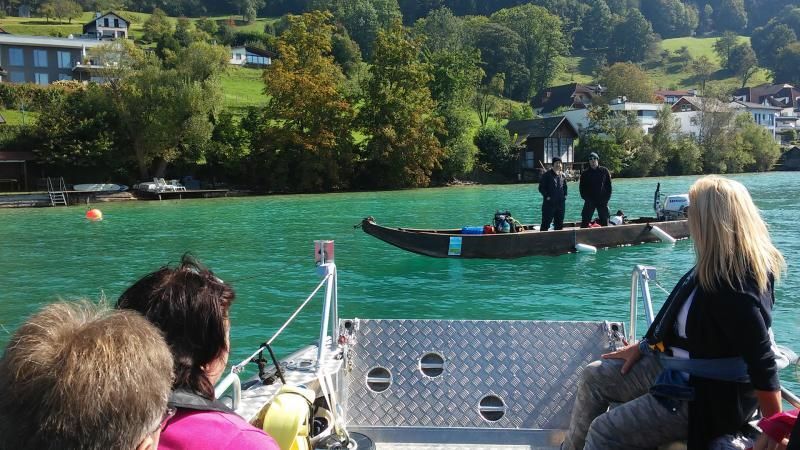
That thinking shaped the communication concept around the Zeitensprung research project and its underwater excavations at Lake Attersee. The project took place in the wider context of the UNESCO World Heritage site Prehistoric Pile Dwellings around the Alps. For Kuratorium Pfahlbauten, this context came with responsibilities that went beyond communicating the research itself. The UNESCO mandate included protecting the archaeological heritage and involving people in the regions. The excavations therefore also provided an opportunity to build broader understanding of the pile dwellings, their protection and why that protection matters.
That made the analysis of the audience a strategic starting point. For the Attersee campaigns, the local population was the primary target group, but even that was far from homogeneous. Available data on primary and secondary residence, internet use, age, education and occupation were considered before the excavations. The high number of second-home owners mattered, as did tourism and the wider population of Upper Austria. “The public” was never simply one public. Permanent residents, people with second homes and visitors had different stakes in the region and different information needs.
The communication goals were equally concrete. One goal was very practical: people should know whom to contact with questions about the protection of pile-dwelling sites, how to reach them, and feel comfortable doing so. Building trust was part of that. Another objective was to make the expertise of the institutions and researchers involved more visible and strengthen their reputation.
Creating understanding was another important goal. The communication and outreach programme was also used to explain restrictions connected with protecting underwater cultural heritage. The point was not simply to communicate that restrictions existed, but to create understanding of why they existed.
The programme also opened a window into publicly funded research: what actually happens during an underwater excavation, how researchers work and what this kind of research involves. That is more than reporting results. It gives people context for the research itself and for the public resources invested in it.
These goals were different, and that is precisely the point. Before choosing a format, two targets need to be clear: the people you need to reach and the outcome you want to achieve. Once both are defined, the right communication tool becomes much easier to identify. The format is no longer the starting point. It becomes the answer to a strategic question.
If visibility is the target, media relations may be the right choice. If deeper understanding is needed, a science blog, exhibition or public talk can offer more space. If building trust matters, direct contact with researchers can do something a press release cannot. And if people are meant to participate in the research itself, communication alone will not be enough.
That is why the order matters: define the targets first. Then choose the format.
It sounds simple, but the order is often reversed, especially when familiar channels, established formats or existing routines are already there. The conversation can then begin with what to publish, organise or produce rather than with what the communication is meant to achieve.
With complex research, getting that order right matters even more. Scientific language, specialist knowledge, existing attitudes and different levels of prior understanding already shape how a message is received. The choice of format can create another barrier or help overcome one. It can make the difference between information simply being available and communication actually supporting its intended objective.
Good science communication therefore starts long before the first press release, post or event. It starts by defining its targets: who needs to be reached, and what should the communication achieve? Only then does the choice of channel or tool really make sense.
And that principle reaches far beyond science communication. Whether the subject is research, transformation or strategy execution, communication becomes much more useful when it starts with purpose rather than output.
This is the second in a short series on science communication, science outreach and participation in research.
This post draws on my article: Löw, C. (2026), “Wissenschaftskommunikation, Wissenschaftsvermittlung und Wissenschaftspartizipation zu den Unterwasser-Ausgrabungen im Attersee.” In: Die Pfahlbaustationen Seewalchen I und Weyregg II im Attersee/OÖ. Projekt Zeitensprung 2015–2017, OÖ Landes-Kultur GmbH, pp. 318–326. The volume is available from OÖ Landes-Kultur GmbH.
(Photo Credit: Kuratorium Pfahlbauten /OÖLM)